Chiang Mai Family Travel Guide — by the Thaan Aoan Team
25 Best Things to Do in Chiang Mai with Kids
2026 Local Guide
Ages and budgets • Weather and timing • Getting there • Stroller access
Updated July 10, 2026
CHIANG MAI WITH KIDS
Plan a Family Trip Without the Guesswork
Planning a trip to Chiang Mai with kids? This local guide compares 25 family-friendly places by age, budget, weather, travel time from the Old City, and stroller access. Start with the quick comparison below, then open each attraction for practical tips, current price guidance, opening hours, and directions.
Local perspective: Written and reviewed by the Thaan Aoan team in Chiang Mai.
JUMP TO A SECTION
Table of Contents
Quick Comparison: 25 Things to Do with Kids
| Attraction | Best for | Setting | Time | Typical cost | From Old City | Stroller |
|---|---|---|---|---|---|---|
| Wat Phra That Doi Suthep | All ages | Temple / outdoor | 1.5–3 hrs | Low | 30–45 min | Partial |
| Wat Pha Lat & Monk’s Trail | Age 6+ for hike | Outdoor | 1.5–3 hrs | Free / park fee may apply | 15–25 min | No |
| Royal Park Rajapruek | All ages | Outdoor / tram | 2–5 hrs | 70–200 THB | ~20 min | Yes |
| Queen Sirikit Botanic Garden | Age 5+ | Outdoor / glasshouses | 3–5 hrs | Paid | 45–60 min | Partial |
| Ang Kaew Reservoir | All ages | Outdoor | 1–2 hrs | Free | 10–20 min | Yes |
| Huay Tung Tao Lake | All ages | Outdoor | 2–4 hrs | 50 THB + food | 20–35 min | Partial |
| Bua Tong Sticky Waterfalls | Age 6+ | Outdoor | 3–5 hrs | Free | 60–90 min | No |
| Mae Sa Waterfall | Age 6+ | Outdoor | 2–4 hrs | 20–100 THB | 35–50 min | No |
| Tha Phae Gate & Old City | All ages | Outdoor | 1–3 hrs | Free | Central | Yes |
| Wat Phra Singh | All ages | Temple | 1–2 hrs | Free–50 THB | Central | Partial |
| Wat Chedi Luang | All ages | Temple | 1–2 hrs | Free–50 THB | Central | Partial |
| Three Kings Monument | All ages | Outdoor | 15–60 min | Free | Central | Yes |
| City Arts & Cultural Centre | Age 5+ | Indoor | 1–2 hrs | 40–90 THB | Central | Yes |
| Lanna Folklife Centre | Age 5+ | Indoor | 1–2 hrs | 20–90 THB | Central | Yes |
| Chiang Mai Zoo | All ages | Outdoor / hilly | 3–5 hrs | 120–350+ THB | 10–25 min | Partial |
| Chiang Mai Zoo Aquarium | All ages | Indoor | 1.5–3 hrs | 350–450 THB + zoo entry | 10–25 min | Yes |
| Chiang Mai Night Safari | All ages | Outdoor / tram | 3–5 hrs | 450–1,200 THB | 20–35 min | Yes |
| Elephant Nature Park | Age 5+ | Outdoor | Half/full day | Tour price varies | 60–90 min | Limited |
| Sunday Walking Street | All ages | Outdoor market | 2–4 hrs | Free + food | Central | Carrier better |
| Chiang Mai Night Bazaar | All ages | Outdoor / covered | 2–3 hrs | Free + shopping | Central | Partial |
| Warorot Market | All ages | Indoor / outdoor | 1–2 hrs | Free + food | Central | Carrier better |
| Central Chiang Mai | All ages | Indoor | 2–5 hrs | Free + spending | 15–30 min | Yes |
| Art in Paradise Chiang Mai | All ages | Indoor | 1.5–3 hrs | Verify current listing | 20–30 min | Yes |
| Grand Canyon Water Park | Age/height limits | Outdoor | 3–6 hrs | 750–950 THB | 30–45 min | Limited |
| Pongyang Jungle Coaster | Age/height limits | Outdoor | 3–6 hrs | Activity price varies | 45–75 min | No |
Planning note: Prices, schedules, age limits, and access conditions can change. Confirm with the attraction before travel.
Key Takeaways
In this guide, I’ll share 25 family-friendly attractions in Chiang Mai, Thailand, along with practical “local tips” covering how long to stay, what to prepare, and how to get there from the Old City. Additionally, you’ll find prices, opening hours, and Google Maps links for each location.
If you’re planning your trip and want a clear list you can actually use, this article is made for you.
Essential Tips Before You Go
1. When visiting a temple—make sure to cover your shoulders and knees as part of the standard dress code.
2. When heading to a local market—bring smaller bills like 100-baht and 50-baht notes for easier transactions.
3. When traveling with young children who can’t walk yet—bring a front carrier for temple steps, crowded markets, and uneven trails; a compact stroller is still useful in malls, gardens, and flatter parts of the Old City.
4. For transportation—download the Grab, Bolt, and Maxim apps before arriving. All three work like Uber, with Grab being the most reliable option.
5. Many major temples have restrooms, but facilities vary. Carry tissues and small change just in case.
6. Apply sunscreen regularly—don’t let sunburn ruin your family vacation.
Quick tip: If you want a ready-made plan, check out our simple itinerary post: Chiang Mai 3-Day Itinerary. Prices may vary by season and booking channel.

Quick Picks: Best Family-Friendly Attractions for Short Trips (1-3 Days)
If you only have a few days, here are the top family activities in Chiang Mai that offer the best mix of culture, nature, and fun for both kids and adults. These family-friendly spots are easy to reach and provide memorable experiences without overwhelming your schedule.
- 1) Wat Phra That Doi Suthep (views + culture)
2) Chiang Mai Central Festival (trendy shopping)
3) Bua Tong Sticky Waterfalls (Climb the Rocks!)
4) Chiang Mai Night Safari (evening activity)
5) Chiang Mai Zoo + Aquarium (classic family day)
6) Sunday Walking Street (fun night market)
7) Grand Canyon Water Park (Water Day for Kids)
8) Elephant Nature Park
Nature & Gardens: 8 kid-friendly places in Chiang Mai
Chiang Mai is the perfect destination for families who want to connect with nature. Within a single day, you can visit a botanical garden, chase waterfalls, and enjoy panoramic viewpoints—all without long-distance travel. Moreover, these family-friendly places around Chiang Mai provide both adventure and relaxation. Chiang Mai’s geography also makes it a top place for mountain views, forest walks, and nature-focused day trips.
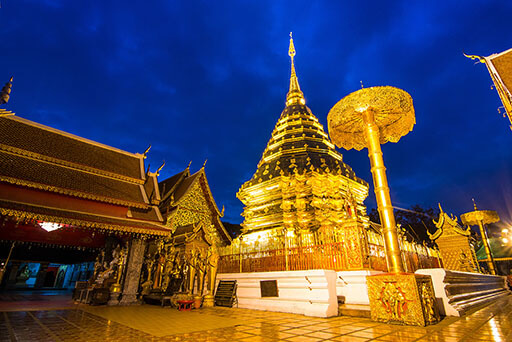
This is the “postcard view” of Chiang Mai and one of the most iconic family-friendly attractions in the region. Wat Phra That Doi Suthep is also on our top 5 temples to visit.
If you’ve seen a “must visit” list of Chiang Mai attractions, Wat Phra That Doi Suthep is almost always number one—and for good reason. Sitting on Doi Suthep mountain, Wat Phra That Doi Suthep is known for its stunning views over the city of Chiang Mai. The temple is located on a mountain, and from its vantage point, visitors can see for miles in every direction. The views are particularly beautiful at sunset, when the city is bathed in golden light—the climb, the cool air, the bell sounds, and then the view that makes you understand Chiang Mai’s geography in one glance.
According to legend, the temple was founded in the 14th century after a monk discovered bone relics of the historical Buddha at the site. The temple was built to house these relics and is considered a significant pilgrimage site for Thai Buddhists.
Many Thai visitors come here with real devotion, not just for photos. That’s why I recommend arriving with a “quiet mindset”—even if you’re excited. When you walk slowly, you’ll notice details: the golden chedi catching light, the patterns in the naga staircase, and the way incense and mountain breeze mix together.

Don’t miss these highlights
1. The golden chedi (stupa)—walk around it slowly and you’ll feel the atmosphere change
2. City viewpoint—best when the air is clear (early morning is often the safest bet)
3. Temple bells, murals, and smaller shrines—the “quiet corners” are the best part
Price: 30 baht / Tram is 20 baht
Time needed: 1.5–3 hours
Transportation from Old City: ~25–40 minutes by car/Grab (traffic can change).

Wat Pha Lat is a small forest temple on the slopes of Doi Suthep, often described as a peaceful “hidden temple” compared to the busy crowds at Wat Doi Suthep. Well, it used to be peaceful but recently has been gaining a lot of popularity and is pretty busy these days. It’s also known as Wat Sakadagami and historically served as a resting point for pilgrims heading up the mountain.
The Pha Lat Nature Trail (commonly called the Monk’s Trail) is the short jungle hike that connects the city side of Chiang Mai to Wat Pha Lat—and can be continued further uphill to Wat Doi Suthep if you want a longer trek. The hiking trail Wat Pha Lat itself is not that difficult and is an attraction that is family-friendly even for small children. My son has been doing this trail since he was 6 years old and really enjoys it.
A quick background (history)
1. Founded: commonly dated to 1355, during the reign of King Kuena of Lanna.
2. Name meaning: Wat Pha Lat is often explained as “the monastery/temple at the sloping rock.”
3. Why this location: local tradition links the temple to the Doi Suthep pilgrimage story, making it part of the spiritual route up the mountain.

Main attractions at Wat Pha Lat
- Naga-flanked stairways & old stone structures (signature photo spots).
- Forest shrines and Buddha statues spread across mossy, shaded paths.
- The waterfall area: the attraction listing notes a stream flowing into a beautiful waterfall, which is part of what makes the temple feel “alive” and refreshing.
Price: 100 baht for an adult/50 baht for a child for the trail—cash only, free if you go by road.
How to get there
- Option A) Go directly to Wat Pha Lat by road (no hike)
- Best for: families, seniors, quick visits, and sunset vibes without sweating.
- You’ll arrive near the temple area by car/taxi, then walk short paths inside the complex.
- Option B) Hike the Monk’s Trail (most popular experience)
- Best for: first-timers who want the “hidden temple in the forest” feeling.
- A widely used starting point is near the city-side foothills (around the Chiang Mai University/Huay Kaew Road area).
Typical travel time (from city areas)
- From Old City/Nimman, most people reach the trail area or road access in roughly 10–25 minutes by car/taxi (traffic dependent).
- Then add 45–90 minutes if you’re hiking in and taking photos.

Royal Park Rajapruek is a large botanical garden complex in Chiang Mai, created from the Royal Flora horticultural exposition era and now run as a year-round attraction. It’s famous for huge landscaped gardens, international-themed zones, and a royal pavilion (Ho Kham Luang)—with a free electric sightseeing tram that makes exploring easy even on hot days.
A quick background (history)
1. The site is strongly tied to Chiang Mai’s international horticultural exposition (Royal Flora Rajapruek), held to honor the Thai monarchy and royal projects, and it evolved into a permanent garden attraction afterward.
2. Today, the park is over 500 rai and is organized into Thai gardens, international gardens, and organizational/corporate gardens.
- Scale + structure: This is not a small city park—it’s a full “garden destination” with multiple themed zones spread across a very large area.
- Royal pavilion centerpiece: Ho Kham Luang gives a distinctly “Chiang Mai / Lanna-style” architectural highlight that most gardens don’t have.
- Tram-friendly: You can comfortably visit with kids or older travelers because the electric tram service is completely free, which is why this is considered one of the top things to do in Chiang Mai with kids for all ages.
Main attractions
- From the park’s own “popular garden” list, the big highlights include:
- Ho Kham Luang (Royal Pavilion)
- Tropical Rainforest Dome
- Flower Pavilion / Flower displays
- New Theory Agriculture Garden (royal-project style learning garden)
- Desert Plant Garden
- The tram (Big Gardens + Tram experience)
- The park provides a free electric sightseeing tram to help visitors loop around key zones.
- Park materials have described the tram as stopping at multiple stations around the park (often mentioned as 8 stops in older visitor documents).
Activities
- Garden walking & photography (best for families and casual visitors)
- Learning-style visits in themed/domestic agriculture zones (good for visitors interested in Thai royal projects)
- Cycling inside the park (bike rentals available)
- Golf cart touring (useful for groups, seniors, or hot afternoons)
Entrance fees (confirmed)
Official admission (general tickets):
- Thai adult: 100 THB
- Thai child (100–140 cm): 70 THB
- Foreigner adult: 200 THB
- Foreigner child (100–140 cm): 150 THB
- Children under 100 cm: free
Opening hours: Daily 08:00–18:00. Check the official admission page before visiting.
How to get there
- Grab usually takes about 20 minutes from the old city.
How long to spend (recommended)
- Quick visit (1.5–2.5 hours): Tram loop + Royal Pavilion + 1–2 garden zones
- Best experience (3–5 hours): Add domes + slow walking/photo stops + café/meal break
- Full day (5–7 hours): For garden lovers (some visitors comfortably spend most of the day).

If you want a “big nature day” close to Chiang Mai without doing a hardcore hike, Queen Sirikit Botanic Garden is one of the best choices and one of the top family-friendly attractions in Chiang Mai, Thailand. It sits in the Mae Rim area, surrounded by mountain forest, and it feels more like a nature park and botanical museum than a simple garden. The scale is the main point: wide landscapes, cool air compared to the city, beautifully kept zones, and signature attractions like the Glasshouse Complex (tropical/rainforest-style indoor gardens) and the Canopy Walkway—where you can walk above the trees and see the valley from a completely different angle.
A quick background (history)
The garden is part of Thailand’s botanical conservation efforts and was established in the early 1990s—created in honor of HM Queen Sirikit and developed into a major research and public education site.
It’s located on a large mountainous area in Mae Rim, which is why the garden has both “designed” zones (lawns, flower beds, glasshouses) and real forest trails.
This isn’t only for sightseeing—QSBG is also known for plant conservation, learning programs, and botanical collections that change through the seasons.

Why it’s special
- Mountain setting: cooler, greener, and more “escape-from-the-city” than most gardens.
- Best of both worlds: curated gardens and natural forest trails in one place.
- The Canopy Walkway: a rare “walk above the trees” experience in Northern Thailand.
- The Glasshouse Complex: perfect when it’s hot or rainy or you want a focused “wow” zone without walking forever.
Don’t miss these highlights
Canopy Walkway (Canopy Walks) — the forest-top walk with wide views; go when the sky is clear for the best photos.
The Glasshouse Complex — a must for first-timers (tropical / rainforest-style environments and themed displays).
Forest trails + waterfall zones — if you want the “real nature” side of the garden (bring comfy shoes).
Activities
- Canopy Walk + scenic viewpoints
- Glasshouse touring and plant exhibits
- Easy nature walks/short trails (family-friendly if you keep it simple)
- Photography day (flowers, landscapes, and “greenhouse light” shots)
- Cafe stop + souvenir/gift shop browsing (nice break in the middle)
Entrance fees
- Foreigner: 150 THB
- Thai adult: 50 THB / Student: 20 THB / Children under 12: free
- Car fee inside the garden area: 100 THB per vehicle
Typical travel time (from city areas)
From Old City / Nimman: ~35–60 minutes by car/Grab (traffic dependent).
How long to spend (recommended)
- Quick visit (2–3 hours): Glasshouses + Canopy Walkway + 1 short trail
- Best experience (3–5 hours): Add slow walking/photo stops + café break
- Full day (5–7 hours): For garden lovers who want multiple trails and zones
Local tips (small things that matter)
- Morning or late afternoon is most comfortable (midday sun can feel strong).
- Wear shoes you can walk in (this is a big place).
- Bring water and a light mosquito repellent if you plan to do forest trails.

This is Chiang Mai’s easiest “free sunset walk” with Doi Suthep in the background.
Ang Kaew Reservoir is a calm, scenic lake inside Chiang Mai University—originally built to store water for the campus, but today it’s one of the city’s favorite places for an easy walk or run. The vibe is simple and local: students, families, and walkers circling the water, with an open view toward Doi Suthep mountain. If you want something peaceful and outdoorsy without leaving the city (and without paying an entrance fee), this is one of the best choices.
A quick background (history)
- 1. Ang Keaw Reservoir is named after the nearby Huay Kaew Waterfall area and was created as a water reservoir for Chiang Mai University.
- 2. Over time, it became a popular “everyday nature” spot for students, staff, and locals—especially for walking and running in cooler hours.
- 3. The main attraction is the scenery: a wide open lake with Doi Suthep and its temple silhouette in the distance.

Why it’s special
- It’s one of the best “local lifestyle” experiences in Chiang Mai—no ticket, no tour, no crowds like the big temples.
- The view feels surprisingly dramatic for a city spot: water + green campus + mountain backdrop.
- It’s flexible: you can do a quick 30–45 minute lap, or turn it into a longer run by linking campus paths.
Don’t miss these highlights
- 1. Mountain reflection photos — go at sunrise or late afternoon for the nicest light.
- 2. The lakeside loop — do at least one full lap (easy, flat, and relaxing).
- 3. The “slow moment” — sit on the grass for 10 minutes; this is where Ang Kaew feels most special.
Activities
- Walking/jogging (the reservoir loop is roughly ~1–1.6 km depending on the route you take)
- Longer running routes (combine nearby campus paths for a longer loop)
- Photography (sunrise, sunset, after-rain mood)
- Picnics / relaxing on the lawn (keep it tidy and respectful)
Price: Free
Opening hours: 05:00–22:00
Note: Chiang Mai University has multiple gates with different open/close times—its main entrance is open 24 hours, but some other gates close earlier.
How to get there
- Option A) Grab (most convenient)
- Tell the driver “Ang Kaew Reservoir, Chiang Mai University” and enter via the main CMU entrance on Huay Kaew Road.
- Option B) Scooter / car (most flexible)
- Easy if you want to combine Ang Kaew with other nearby spots (Nimman, Huay Kaew area).
- Option C) Walk / bike (best if you’re staying near Nimman)
- If you’re already in the Nimman/Huay Kaew area, it can be a short ride or a longer walk into campus.
Time needed: 45–90 minutes (one lap + photos)
Best experience: 1.5–2.5 hours (slow walk + relaxing + exploring a bit more of campus)
Transportation from Old City: ~10–20 minutes by car/Grab (traffic can change).

This is where Chiang Mai locals go when they want a “beach day” without the beach—making it a truly authentic, family-friendly attraction in Chiang Mai, Thailand.
Huay Tung Tao Lake (also spelled Huay Tueng Thao) is a large reservoir just outside the city, set against a beautiful mountain backdrop. The experience here is simple—but really memorable: you arrive, choose a lakeside bamboo hut (many sit right on the water), and spend a slow afternoon eating, relaxing, and watching the light change over the lake. It’s not a “touristy attraction” in the traditional sense. It’s more like a local weekend habit—easy, affordable, and surprisingly calming.
A quick background (history)
Huay Tung Tao is a man-made reservoir built to support water management for the surrounding area.
Over time, the lake became a popular local hangout—especially for picnics, walking, cycling, and long lakeside lunches in bamboo huts.
The signature “thing to do” here is not one single monument—it’s the whole atmosphere: water, mountains, and a very Chiang Mai pace of life.
Why it’s special
- A true local vibe: you’ll see families, groups of friends, and cyclists—especially on weekends.
- The bamboo huts: you can sit right over the water with shade and a breeze.
- It’s flexible: you can come for a quick walk or stay half a day without feeling rushed.
- Sunset is genuinely beautiful here because the lake stays wide and open, with mountains framing the view.

Don’t miss these highlights
Pick a bamboo hut on the water—then order a simple Thai lunch and take your time.
The late-afternoon “golden hour”—this is when the lake feels most photogenic and peaceful.
A slow loop walk by the shore—even 20–30 minutes makes the whole visit feel more complete.
Main attractions
- Lakeside bamboo huts and casual restaurants around the water
- Wide open lake views with a mountain backdrop
- Plenty of space to walk, sit, and relax (it rarely feels cramped because the area is so spread out)
Activities
- Lakeside lunch and relaxing (the classic)
- Walking/jogging
- Cycling around the lake
- Swimming (only in safe areas and when conditions allow)
- Paddle boating (when available)
- Birdwatching in the cooler morning hours
Price (entrance)
Entrance fee: 50 THB / person
Opening hours
Daily: 8:00 am – 5:00 pm
How to get there
Option A) Grab (most convenient)
Search: “Huay Tung Tao Lake” or “Huay Tueng Thao Reservoir” and set the destination to the lake entrance gate.
Option B) Scooter / car (easy and flexible)
- The most straightforward route is along Canal Road (toward Mae Rim), passing the 700 Year Stadium area, then turning toward the lake entrance when you see the signs.
Option C) Red songthaew (good for groups)
Best if you’re traveling as a group and want a pickup time arranged for the return.
Typical travel time (from city areas)
Transportation from Old City/Nimman: ~20–35 minutes by car/Grab (traffic can change).
How long to spend (recommended)
- Quick visit (1–2 hours): photos + short walk + drink/snack
- Best experience (2.5–4 hours): lakeside lunch + relaxing time + a walk
- Half-day (4–6 hours): for a slower pace (especially on a nice weather day)
Budget guide (simple ranges)
Entrance + lunch + drinks: ~200–500 THB per person (more if you order fish or a bigger shared meal)

This is one of the most “Chiang Mai-only” experiences you can do in a single day: you can literally walk up a waterfall. As one of the most unique family activities in Chiang Mai, it offers an adventure you won’t find elsewhere.
Bua Tong (often called the Sticky Waterfalls) is located in Mae Taeng District, about 60 km north of the Old City. The rock surface feels almost grippy under your feet because mineral deposits (calcium carbonate) coat the limestone, creating a rough texture that makes climbing possible without slipping like a normal waterfall. It’s playful, refreshing, and surprisingly family-friendly—especially if you go early and take it slow.
A quick background (history)
The waterfall is part of the Namtok Bua Tong–Nam Phu Chet Si area…
The “sticky” effect comes from mineral-rich spring water…
The waterfall system is fed by Nam Phu Chet Si…
Why it’s special
- You can climb up the waterfall (not beside it) without technical gear—just careful steps and common sense.
- It’s not a single viewpoint or building—the “wow” is the whole moment: white limestone terraces, cool water, jungle shade, and the fun of moving upward.
- There’s an extra mini-adventure nearby: the short walk to Nam Phu Chet Si (Seven-Colors Spring), the source of the water.
Don’t miss these highlights
Climb at least 2 levels—most people stop too early; the upper sections feel more peaceful.
The side ropes—they make the climb easier for kids and anyone who wants extra balance.
Nam Phu Chet Si (Seven-Colors Spring)—a short walk beyond the waterfall area, and it helps you understand why this place is “different.”
Main attractions
- The Sticky Waterfalls (multi-level limestone terraces you can climb)
- Nam Phu Chet Si (Seven-Colors Spring)—the spring source in the forest, about a short walk from the park HQ area
- Picnic/rest area + small local snack/food options near the parking zone (simple but convenient)
Activities
- Waterfall climbing (up and down)
- Swimming/cooling off in the pools (choose calm spots and avoid strong flow)
- Short forest walk to the spring
- Nature photos (the rock texture and water patterns look great on camera)
Price
- Entrance fee: Free (bring small cash for snacks/parking services if needed).
- Lockers: 30 THB (limited availability).
Opening hours
8:00 am – 5:00 pm
How to get there
Option A) Scooter / car (best flexibility)
Drive north toward Mae Taeng; it’s a straightforward day trip route, and you’ll have full control over how long you stay.
Option B) Grab / private driver (easy, especially for groups)
If you’re not driving, hiring a private ride can work well—especially if you split the cost with friends.
Option C) Day tour
Many tours pair Sticky Waterfalls with nearby nature stops; this is good if you want a “no-planning” day.
Typical travel time (from city areas)
Transportation from Old City: about 1–1.5 hours by car (traffic can change).
Time needed
- Quick visit: 2–3 hours (climb + photos + short rest)
- Best experience: 3–5 hours (climb slowly, swim, then walk to Nam Phu Chet Si)
- Full day: 5–7 hours (very relaxed pace + lunch stop on the way)
Local tips (small things that matter)
- Bring water shoes if your feet are sensitive—many people climb barefoot, but the rock texture can feel rough after a while.
- Go early on weekends; it can get busy later in the day.
- Skip the climb after heavy rain if the flow feels too strong—take the safer paths and enjoy the lower pools instead.

If you want a waterfall day that feels “properly green” but is still easy to do as a half-day trip, Mae Sa Waterfall is one of the best choices near Chiang Mai and ranks among the most accessible kid-friendly places in Chiang Mai for nature lovers. It sits in the Mae Rim area, inside Doi Suthep–Pui National Park, and the experience is all about a long, shaded walk with multiple waterfall levels—so you can stop whenever you feel like it, rather than rushing to see one single viewpoint.
Mae Sa is a ten-tier waterfall, and each tier is spaced out (roughly 100–500 meters from one to the next). That spacing is what makes it fun: you’re constantly “discovering” the next section, with plenty of spots to rest along the way.
A quick background (history)
Mae Sa Waterfall is part of Doi Suthep–Pui National Park’s expanded protected area (the park boundary expansion included Mae Sa Waterfall and nearby watershed forests).
The waterfall is known for flowing year-round and for its forest setting—big trees keep the area cooler and pleasant for walking.
The “main attraction” is the journey: a multi-tier waterfall walk rather than a single dramatic drop.
Why it’s special
- You get multiple waterfall moments in one visit—perfect if you like walking and don’t want the trip to end after 5 minutes.
- The route is great for a slow-paced nature day: picnic energy, shade, and lots of stop points.
- It’s close enough to feel easy but far enough that it actually feels like you “left the city.”
Don’t miss these highlights
Walk beyond the first couple of tiers—the vibe gets quieter the higher you go.
Choose one “rest tier”—sit, snack, and enjoy the sound of water before continuing.
Do the full forest stroll if you have time—this is one of those places where the walk is the point.
Main attractions
- 10-tier waterfall system with a long forest trail (many people treat it like a nature walk with waterfall breaks).
- Shaded picnic-style atmosphere near the lower area, plus simple vendors around the parking zone (good for drinks/snacks).
Activities
- Waterfall walking (pick your pace: quick stroll or longer hike)
- Picnic / relaxing in the shade
- Photography (best after rain when the flow is stronger—if the area is open and safe)
- Cooling off near calmer pools (always use common sense—flow can change fast)
Price (entrance)
- Thai: Adult 20 THB / Child 10 THB
- Foreigner: Adult 100 THB / Child 50 THB
Opening hours
- The national park’s waterfalls and main visitor areas are generally open 8:00 am – 4:00 pm.
- In periods of heavy rain, Mae Sa Waterfall can be temporarily closed for safety.
How to get there
Option A) Scooter / car (best flexibility)
Mae Sa Waterfall is reached via Mae Rim–Samoeng Road; the park notes it’s about 12 km along this route from the Chiang Mai side, roughly around 30 minutes depending on traffic.
Option B) Grab / private driver (easy, especially for families)
Set destination: “Mae Sa Waterfall,” and plan a return pickup time if you don’t have a signal deep inside the area.
Option C) Public bus (budget + local experience)
The park describes using public buses via Mae Rim: take the Chiang Mai–Samoeng bus route and connect around the Mae Rim area/intersection as needed to reach the waterfall.
Typical travel time (from city areas)
Transportation from Old City/Nimman: ~30–45 minutes by car/Grab (traffic can change).
Time needed
- Quick visit: 1.5–2.5 hours (lower tiers + photos)
- Best experience: 3–4.5 hours (walk several tiers, relax, snack break)
- Half-day: 4–6 hours (for people who want to go higher and take it slow)
Local tips
- If you’re visiting in rainy season, check conditions—closures can happen after heavy rainfall.
- Bring shoes that can handle wet paths, and pack a small towel if you plan to get near the water.
- If you’re short on time, don’t rush—pick a few tiers and enjoy them properly.
Culture & Easy Walks: 6 family-friendly places around Chiang Mai
Visiting Chiang Mai’s cultural family-friendly attractions feels special because you’re not just “seeing” culture—you’re stepping into a living one that’s still practiced every day. Since Chiang Mai was the heart of the Lanna Kingdom, the architecture, design, language influence, food, and even local behaviors and rituals have a northern character you won’t find in Bangkok or the beaches. As a result, these experiences offer families an authentic glimpse into Thailand’s rich heritage.

This is the “start here first” landmark of Chiang Mai—and the easiest way to feel the Old City in one walk.
Tha Phae Gate is one of the most popular family-friendly attractions in Chiang Mai and the most famous gate. Today’s brick gate is a reconstruction, but the location still carries the same role: it’s the eastern entrance into the Old City, a meeting point, and a place where the city’s history and daily life overlap. Step through the gate and you’re immediately in the Old City rhythm—temples, small cafés, side streets, and the moat that wraps around it all.
The Old City Moat Walk is exactly what it sounds like: a simple walk along the water-lined perimeter of the Old City. It’s flat, easy, and flexible—you can do a short stretch for photos or turn it into a longer loop when you want a calm “no-plan” activity that still feels meaningful.
A quick background (history)
Tha Phae Gate was originally part of Chiang Mai’s fortified wall-and-moat system from the Lanna period, built as the main eastern gateway into the city.
The original gate structure was later removed, and the gate you see today is a reconstructed version built on the historic site.
- The Old City is laid out as a compact square surrounded by a moat—so walking the moat is one of the simplest ways to understand the city’s shape and “old capital” design.
Why it’s special
- It’s Chiang Mai’s classic “first impression” spot—easy to find, easy to meet friends, and easy to connect to the Old City from here.
- You get a two-in-one experience: a historic landmark photo at the gate, then a peaceful walk beside water and old brick walls.
- It works at any pace: quick photos in 15 minutes or a slow walk that turns into a full morning.
- On Sundays, this area is also the natural starting point for exploring the Old City street-market atmosphere.
Don’t miss these highlights
The front plaza at Tha Phae Gate—the iconic photo spot (best early morning for clean shots).
One “moat-side” stretch—walk 15–25 minutes in either direction and you’ll get the classic Old City atmosphere without trying too hard.
Golden hour walk—late afternoon light makes the brick walls and trees look especially beautiful.
Main attractions
- Tha Phae Gate (historic landmark + plaza)
- The Old City moat and remaining wall sections
- The “walkable Old City” feeling: small streets, temples, and cafés just inside the gate
Activities
- Photography (gate + brick wall shots + moat reflections)
- Walking/jogging along the moat
- Cycling (best in the morning when traffic is calmer)
- People-watching (street life, local routines, and seasonal events)
- Pair it with a temple hop inside the Old City (easy to do without transportation)
Price: Free
How to get there
Option A) Walk (if you’re already in the Old City)
- Tha Phae Gate sits on the eastern edge of the Old City—very easy to reach on foot from most central streets.
Option B) Grab (easy from Nimman or riverside areas)
- Set the destination to “Tha Phae Gate,” and you’ll be dropped right at the plaza.
Option C) Red songthaew (simple and local)
- Tell the driver “Tha Phae Gate” (most drivers know it instantly).
Typical travel time (from city areas)
- From inside the Old City: 0–15 minutes on foot (depending on where you start).
- From Nimman: ~10–20 minutes by car/Grab (traffic can change).
- From Night Bazaar/Riverside: ~5–15 minutes by car/Grab.
Time needed
- Quick visit: 30–60 minutes (gate photos + short moat walk)
- Best experience: 1.5–2.5 hours (slow moat walk + café stop + explore inside the Old City)
- Full loop walk: about 2–3 hours if you circle the entire moat at an easy pace (longer if you stop often)
Local tips
- Go early if you want clean photos at the gate—midday is bright and busy.
- If you do a longer moat walk, bring water (Chiang Mai heat builds up even on “easy” walks).
- The moat loop is easiest when you treat it like a gentle city stroll—not a speed-walk mission.
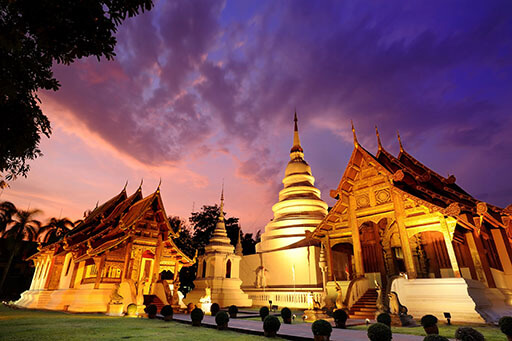
This is Chiang Mai’s “Lanna art showcase” temple—beautiful, central, and deeply respected. Wat Phra Singh is also in our top 5 temples to visit.
Wat Phra Singh sits inside the Old City and feels like the place where Chiang Mai’s history becomes easy to see: layered roofs, gold details, quiet courtyards, and some of the best surviving Lanna-style murals in town. It’s also home to Phra Buddha Sihing, one of Northern Thailand’s most revered Buddha images, which is why many locals don’t visit this temple just for photos—they come with real devotion.
If you want one Old City temple that combines “wow” architecture with real cultural meaning, Wat Phra Singh is the one, making it a must-visit family-friendly attraction in Chiang Mai.
A quick background (history)
Founded in 1345 during the reign of King Phayu of the Lanna Kingdom.
The temple is famous for Wihan (Viharn) Lai Kham, known for its woodcarving and northern-style murals—and for housing the revered Phra Buddha Sihing image.
During Songkran (April 13–15), Phra Buddha Sihing is traditionally carried in a procession, which shows how important this temple is to Chiang Mai’s living traditions.
Why it’s special
- Lanna art, up close: the murals at Viharn Lai Kham are one of the most memorable “art moments” you can have in the Old City.
- It’s not “just another temple” in the checklist sense—this one is a major spiritual landmark for Chiang Mai because of Phra Buddha Sihing.
- Easy to combine with a full Old City day (and on Sundays, it’s at the end of the Sunday Walking Street route).
Don’t miss these highlights
- Viharn Lai Kham—step inside slowly and look for the famous mural stories (Sang Thong and Suwannahong/Hong Hern).
- The main chedi and classic Lanna rooflines—the “postcard” temple silhouette is strongest from the open courtyard angles.
- Ho Trai (scripture library)—one of the most photogenic traditional library buildings in the Old City temple circuit.
Main attractions
- Viharn Lai Kham (murals + Phra Buddha Sihing)
- Main chedi and surrounding shrines
- Ho Trai (temple library)
Activities
- Temple walk + architecture photography
- Mural-spotting (slow looking is the whole point here)
- Quiet worship/offering (many locals come for blessings)
- If you’re visiting in mid-April: Songkran cultural moments around Phra Buddha Sihing procession (check timing locally)
Price:
- Temple grounds: free to enter
- Foreign visitors: typically 50 THB to enter key halls (often the ticketed area includes Viharn Lai Kham / main worship halls).
How to get there
Option A) Walk (best if you’re already in the Old City)
It’s inside the Old City and very walkable from most central streets.
Option B) Grab / taxi
Set the destination to “Wat Phra Singh,” and you’ll be dropped near the main entrance.
Option C) Red songthaew
- Say “Wat Phra Singh” (it’s a well-known stop for drivers).
Typical travel time (from city areas)
- From Tha Phae Gate: a very easy Old City walk (the Sunday Walking Street route runs between these two points).
- From Nimman: ~10–20 minutes by car/Grab (traffic dependent).
- From most Old City hotels: often ~5–20 minutes on foot.
Time needed (recommended)
- Quick visit: 45–75 minutes (main courtyard + Viharn Lai Kham + a few corners)
- Best experience: 1.5–2.5 hours (slow murals + photos + quieter sections)
- Pair-with-something plan: Add another nearby temple or café stop and you’ve got a perfect half-day.
Local tips (small things that matter)
- Go early morning for softer light, cooler air, and a calmer atmosphere in the mural hall.
- Dress code: cover shoulders and knees (you’ll feel more comfortable and respectful).
- If you’re doing the Sunday Walking Street: Wat Phra Singh makes a great “final stop” before you head out for dinner.
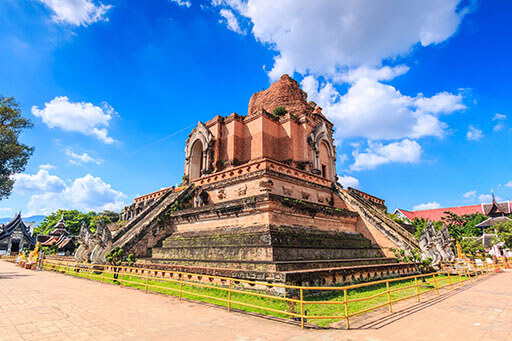
This is the “giant ruined stupa” that makes you feel Chiang Mai’s history in one look. Wat Chedi Luang is also in our top 5 temples to visit.
Wat Chedi Luang—a remarkable family-friendly attraction in Chiang Mai—sits right in the heart of the Old City, and it’s one of those places that feels powerful even before you learn the story. The main chedi (stupa) is massive—partly collapsed, weathered, and beautifully imperfect. Instead of feeling “old,” it feels alive: locals still come to make merit, visitors circle the chedi slowly, and the whole complex has that calm, steady temple atmosphere even though it’s in the city center.
A quick background (history)
Built in stages: construction began in the 14th century under King Saen Muang Ma and was completed in the mid-15th century during King Tilokaraj’s reign; at its peak the chedi was about 82 m tall with a base diameter around 54 m.
The famous moment: the Emerald Buddha was once housed here (installed in 1468), before being moved in 1551—after the chedi was heavily damaged by an earthquake in 1545.
Modern restoration: parts of the chedi were stabilized/restored in the early 1990s with support linked to UNESCO and Japan, and a black-jade Emerald Buddha replica was placed in 1995.

Why it’s special
- The scale is unreal: this is one of the most dramatic Lanna-era temple silhouettes in Chiang Mai’s Old City—ruins, brick texture, and a “timeworn monument” feeling you don’t get from newer-looking temples.
- City Pillar (Sao Inthakin) lives here: Wat Chedi Luang is also where Chiang Mai’s city pillar shrine is kept, moved here in 1800; the annual city pillar festival is typically held around May and lasts about 6–8 days.
- It’s a perfect “Old City anchor”: easy to reach on foot and easy to pair with nearby temples, cafés, and an Old City walk without needing a car.
Don’t miss these highlights
The Great Chedi up close—walk all sides, and look for the elephant sculptures at the base (some are reproductions, and at least one is original).
The City Pillar Shrine (Sao Inthakin) near the entrance is an important local spiritual spot. Note: tradition restricts women from entering the inner shrine building, but you can still pay respects from outside.
Phra Chao Attarot (standing Buddha) in the wihan and the reclining Buddha pavilion—these are the “quiet corners” many people accidentally skip.
Monk Chat (if you’re curious): some days you can speak with monks/novices and ask respectful questions about Buddhism and life in Thailand.
Price (entrance)
- Foreign visitors: often 50 THB (kids usually discounted).
- Thai nationals: Free (polite donations are welcome).
Typical travel time
- From inside the Old City: 5–20 minutes on foot (depending on where you start).
- From Nimman: ~10–20 minutes by car/Grab (traffic dependent).
How long to spend
- Quick visit (45–90 min): chedi loop + main wihan + photos
- Best experience (1.5–2.5 hrs): add city pillar area + reclining Buddha + slower walking
- Deeper visit (2–3 hrs): include Monk Chat, extra shrines + a relaxed pace
Simple tips (small things that matter)
- Best light for photos: early morning or late afternoon.
- Dress code: cover shoulders and knees (bring a light scarf/sarong just in case).
- If you visit during the City Pillar festival period, the atmosphere can feel completely different—more local, more “living tradition.”
Budget (per person)
- Entry: 50 THB
A must-stop-by if you are planning to come to Wat Chedi Luang is Thaan Aoan. Which is located only 80 meters from the temple. We served a variety of breakfast, Thai food, and homemade baked goods.

This is Chiang Mai’s “history in one photo” spot—right in the middle of the Old City.
The Three Kings Monument is one of the most recognizable family-friendly attractions in Chiang Mai. Three bronze kings standing together as if planning the city. It’s set in a wide open square in front of the Chiang Mai City Arts & Cultural Centre, so it naturally becomes a meeting point, a photo stop, and a place where you can pause and understand the story of the city before you explore deeper.
A quick background (history)
The monument honors three rulers closely linked to the founding era of Chiang Mai: King Mangrai, King Ramkhamhaeng, and King Ngam Muang.
It was created to commemorate Chiang Mai’s founding story and placed at a symbolic “city center” location inside the Old City.
The square in front of the monument is often used for public gatherings and cultural moments—so it feels like an active part of Chiang Mai, not a statue hidden in a corner.
Why it’s special
- It’s a landmark that instantly connects you to the “Lanna origin story” in a simple, visual way.
- The location is perfect: you’re surrounded by museums and walkable Old City streets, so it works as a natural starting point for exploring.
- It’s easy and flexible—10 minutes for photos, or a slow hour if you pair it with nearby museums and cafés.
Don’t miss these highlights
- The “planning pose” photo—stand slightly lower and shoot upward to capture all three kings with the Old City backdrop.
- The square atmosphere—walk around the plaza slowly; this is one of the best places to feel the Old City’s pace without traffic stress.
- Pair it with a museum stop—Chiang Mai City Arts & Cultural Centre and the Lanna Folklife Museum are right nearby, so you can turn a quick photo stop into a real “history hour.”
Main attractions
- The Three Kings Monument (the statues + the large inscription base)
- Khuang Three Kings plaza (open public square)
- Nearby museum cluster (great for a “culture-focused” Old City half-day)
Activities
- Landmark photography (morning light or late afternoon looks best)
- Old City walking route starter (great for first-time visitors)
- Museum pairing (history + culture + architecture)
- People-watching during local events (when something is happening in the square)
Price: Free
How to get there
Option A) Walk (best if you’re already in the Old City)
- It’s in the Old City center area—very easy to reach from most Old City hotels.
Option B) Grab / taxi
- Set destination: “Three Kings Monument,” and you’ll be dropped right at the square.
Option C) Red songthaew
- Tell the driver “Three Kings Monument” (most drivers know it immediately).
Typical travel time (from city areas)
- From Tha Phae Gate: ~10–20 minutes on foot (depending on your pace).
- From Wat Phra Singh: ~5–12 minutes on foot.
- From Nimman: ~10–20 minutes by car/Grab (traffic dependent).
Time needed (recommended)
- Quick visit: 15–40 minutes (photos + short walk around the square)
- Best experience: 1–2 hours (add one museum + a café break nearby)
- Culture half-day: 2.5–4 hours (museum + monument + nearby temples in the Old City)
Local tips (small things that matter)
- If you want clean photos, go early—midday can be bright and busy.
- This is a perfect “connect-the-dots” spot: after you visit, it’s easy to continue to Wat Chedi Luang or Wat Phra Singh on foot.

If you want to understand Chiang Mai in a way that temples alone can’t explain, this family-friendly attraction in Chiang Mai is the best place to start.
Chiang Mai City Arts & Cultural Centre is a museum inside the Old City, right behind the Three Kings Monument. The building itself is part of the story—it used to be Chiang Mai’s former government/provincial hall, so walking in already feels like stepping into “old Chiang Mai.” Inside, the exhibitions guide you through the city’s timeline—from early settlement and Lanna’s rise to trade, culture, traditions, and how Chiang Mai changed into the modern city you see today. It’s calm, air-conditioned, and surprisingly engaging, with models, photos, and multimedia displays that make the history easy to follow.
A quick background (history)
The museum is housed in a historic administrative building from the early 20th century that later served as Chiang Mai’s provincial hall.
It was created to help visitors and locals understand Chiang Mai’s identity—its roots, customs, and the story of the Old City.
The permanent exhibition is arranged across multiple rooms, taking you through Chiang Mai’s development from early times to the present.
Why it’s special
- It gives you context: after visiting here, temples and Old City landmarks feel more meaningful because you understand the “why.”
- The location is perfect: you can combine it with the Three Kings Monument, nearby cafés, and an easy Old City walk without needing transport.
- Great for hot or rainy days: this is one of the most comfortable attractions in the Old City.
Don’t miss these highlights
“Constructing the City” sections—the part that helps you understand why Chiang Mai was built in a square, fortified layout.
Lanna life & culture displays—look for everyday-life details (clothing, trade, river life, local customs).
The building itself—take a moment to look at the architecture and stairways; it’s not just a container for exhibits, it’s part of the heritage.
Main attractions
- Permanent exhibitions about Chiang Mai’s history, culture, and identity
- Historic building architecture (old provincial hall style)
- The museum cluster area is easy to pair with the monument plaza and other nearby cultural stops
Activities
- Museum walk-through (self-paced)
- “Old City history hour” (great before temple-hopping)
- Photography (architecture + quiet indoor details)
- Pair with a walking route: Three Kings Monument → museum → Wat Chedi Luang / Wat Phra Singh
Price (entrance)
- Adult: 90 THB
- Child: 40 THB
Opening hours
- 08:30–16:30
- Open Wednesday–Sunday (including public holidays)
- Closed Monday and Tuesday
How to get there
Option A) Walk (best if you’re already in the Old City)
- It’s in the Old City center area, right by the Three Kings Monument plaza.
Option B) Grab
- Set destination: “Chiang Mai City Arts & Cultural Centre” or “Three Kings Monument” (they’re next to each other).
Option C) Red songthaew
- Tell the driver “Three Kings Monument,” and you’ll be within a 1–2 minute walk.
Typical travel time (from city areas)
- From Tha Phae Gate: ~10–20 minutes on foot (depending on your pace).
- From Wat Chedi Luang: ~5–12 minutes on foot.
- From Nimman: ~10–20 minutes by car/Grab (traffic dependent).
Time needed (recommended)
- Quick visit: 60–90 minutes (main rooms + highlights)
- Best experience: 1.5–2.5 hours (slow pace + read details + building/architecture appreciation)
- Culture half-day: 3–4 hours (combine with the nearby museums + a cafe break)
Local tips (small things that matter)
- If this is your first day in Chiang Mai, visit here early—your whole Old City trip will make more sense afterward.
- Go before lunchtime if you want the quietest museum atmosphere.
- If you’re traveling with kids, don’t aim to “finish everything.” Pick a few rooms, then keep it fun and light.

This is the best “one-hour shortcut” to understanding Lanna culture—right in the middle of the Old City.
Lanna Folklife Centre sits directly opposite the Three Kings Monument and works perfectly as a calm, air-conditioned break between temples. The museum is inside a beautiful white colonial-style building that used to be Chiang Mai’s former district court (dating back to 1935), and today it’s filled with galleries that explain everyday Lanna life—beliefs, crafts, rituals, and the visual language you’ll keep noticing in temples around Chiang Mai.

A quick background (history)
The museum is housed in a historic building that once served as the district court of Chiang Mai (dating from 1935), later renovated into a cultural museum space.
- Its purpose is to present Lanna identity through lifestyle and arts—so visitors can understand Chiang Mai beyond “just temples.”
- The exhibitions are organized across many rooms on two floors, designed as an easy introduction to Northern Thai (Lanna) culture and traditions.
Why it’s special
- The location is unbeatable: step out and you’re immediately at the Three Kings plaza, with cafés and Old City walking routes all around.
- It explains the “why” behind what you see in Lanna temples—patterns, offerings, symbols, and craftsmanship.
- Great for hot or rainy days: you still get a meaningful Chiang Mai experience without forcing an outdoor itinerary.
Don’t miss these highlights
Lanna Textiles—one of the most memorable sections (you’ll start recognizing fabrics and patterns around the city afterward).
Ceramics & lacquerware—a quick way to see how “everyday objects” became Lanna art.
Mural painting and Buddhist art rooms—useful context before visiting major Old City temples.
The “History of the building” section adds depth because the building itself is part of Chiang Mai’s story.
Main attractions
- Permanent exhibitions on Lanna lifestyle and arts, including textiles, mural painting, worship offerings, ceramics/lacquerware, sculpture, music & lifestyle, and more.
- The historic building atmosphere (two floors, classic civic architecture).
Activities
- Self-guided museum walk (easy pace, good signage)
- A “culture primer” before temple-hopping in the Old City
- Architecture and exhibit photography (quiet, well-lit rooms)
Price (entrance)
- Thai: Adult 20 THB / Child 10 THB
- Foreigner: Adult 90 THB / Child 40 THB
Opening hours
- 08:30–16:30
- Open Wednesday–Sunday (including public holidays)
- Closed Monday and Tuesday
How to get there
Option A) Walk (best if you’re already in the Old City)
- It’s directly opposite the Three Kings Monument plaza.
Option B) Grab / taxi
- Set destination: “Lanna Folklife Museum” or “Three Kings Monument” (they’re next to each other).
Option C) Red songthaew
- Tell the driver “Three Kings Monument,” and you’ll be a 1–2 minute walk away.
Typical travel time (from city areas)
- From Tha Phae Gate: ~10–20 minutes on foot (depending on pace).
- From Wat Chedi Luang / Wat Phra Singh: ~5–15 minutes on foot.
- From Nimman: ~10–20 minutes by car/Grab (traffic dependent).
Time needed (recommended)
- Quick visit: 45–60 minutes (main rooms + highlights)
- Best experience: 1–2 hours (slow pace + read details)
- If you enjoy museums, around 1.5 hours is a comfortable “full visit” for many visitors.
Local tips (small things that matter)
- Do this before your big temple day—your temple visits will feel more “readable.”
- If you’re short on time, focus on the textiles, ceramics/lacquerware, and mural painting sections first.
Animals & Educational: 4 family activities in Chiang Mai
What makes visiting animals (especially elephants) in Chiang Mai special is that it’s one of the few places where you can see Thailand’s iconic wildlife culture up close, in a setting that’s naturally suited for it—mountains, forest, and cooler weather. Chiang Mai has always had a long connection to animals like elephants (work, ceremonies, local heritage), so the experience often feels more rooted and meaningful than just another tourist attraction. These kid-friendly places in Chiang Mai offer educational experiences that children will remember for years.

If you’re traveling with kids—or you just want an easy “half-day nature outing” close to town—Chiang Mai Zoo is the classic choice and remains one of the most popular family-friendly places around Chiang Mai. It’s set on a green hillside near Chiang Mai University, so the visit feels more like walking through a forest park with animal zones spread across it than a flat city zoo. The main tip is simple: it’s a large area with slopes, so plan your route (or use internal transport) and you’ll enjoy it much more.
A quick background (history)
Chiang Mai Zoo is operated under Thailand’s Zoological Park Organization network, and it has long been one of the city’s major family attractions.
The zoo’s setting (foothills/forest edge) is a big part of the experience—shade, trees, and a “mountain-side park” atmosphere.
Many visitors pair the zoo with nearby Doi Suthep / Old City plans because it’s so close to central Chiang Mai.

Why it’s special
- Hillside layout: it feels greener and more “park-like” than you’d expect for a city attraction.
- Flexible visit style: you can do a quick highlights visit or spend half a day slowly exploring.
- Easy add-on: the Chiang Mai Zoo Aquarium is inside the complex (separate ticket), great for hot or rainy weather.
Don’t miss these highlights
- Pick a “top-to-bottom” plan—start higher, then walk downhill (it feels much easier than climbing up all day).
- Do one slow loop + one focused zone—the zoo is big, so mixing “wander time” with 1–2 must-see areas works best.
- Aquarium add-on (optional)—perfect midday break from heat, and the underwater tunnel is the main reason people go.
Main attractions
- Animal zones across a large, forested hillside layout
- Chiang Mai Zoo Aquarium (separate ticket)
Activities
- Family walk + animal viewing
- Aquarium visit (air-conditioned indoor break)
- Easy “nature day” photos (green backgrounds, wide paths, lots of shade)
Price (entrance)
Zoo entrance (Thai nationals)
- Adult: 130 THB
- Child (3–12): 40 THB
Zoo entrance (non-Thai pricing shown on the zoo/aquarium ticket info)
- Adult: 350 THB
- Child (3–12): 120 THB
Parking (from zoo ticket info)
- Car: 50 THB
- Motorcycle: 10 THB
Aquarium ticket (separate)
- Adult: 450 THB
- Child (3–12): 350 THB
- Open daily: 09:00 am – 05:00 pm
- Note: Aquarium tickets do not include zoo entrance.
Opening hours (zoo)
- 08:00 am–05:00 pm daily
- Some exhibits (Lion–Tiger area) close at 4:30 pm.
How to get there
Option A) Grab (easiest)
- Set destination: “Chiang Mai Zoo” (it’s a very common landmark for drivers).
Option B) Public bus (budget-friendly)
- There are city bus options that stop at the zoo area (useful if you’re staying in town).
Option C) Scooter / car
- Convenient if you want to continue to Doi Suthep viewpoints afterward.
Typical travel time (from city areas)
- From Old City/Nimman: usually ~10–25 minutes by car/Grab (traffic can change).
- Distance reference: about 4 km from central Chiang Mai areas depending on the starting point.
Time needed (recommended)
- Quick visit: 1.5–2.5 hours (highlights + photos)
- Best experience: 3–5 hours (comfortable pace + rest stops)
- With Aquarium: add ~1.5–2.5 hours
Local tips (small things that matter)
- Go earlier if you want to see more animals active—and to avoid the hottest hours.
- If you’re visiting late afternoon, remember some zones close before the main gate time.
- For families: plan one “rest block” (snacks + shade) so the visit stays fun instead of exhausting.

If you want a “cool-down” attraction that still feels like a big Chiang Mai experience, the Chiang Mai Zoo Aquarium is a strong pick among things to do in Chiang Mai with kids—especially for families, rainy days, or anyone who wants a break from temple-hopping heat. The aquarium is inside the Chiang Mai Zoo area and is built around two connected underwater tunnels: one freshwater and one saltwater.
The signature highlight is the tunnel walk. Their official info describes a total tunnel length of 133 meters (66.5 m freshwater + 66.5 m saltwater), with the “Under the Ocean” tunnel itself being 66.5 meters.
A quick background (history)
The aquarium presents freshwater and marine exhibits in one facility, designed around linked underwater tunnels.
The exhibits are organized into 6 themed zones, spread across two levels (upstairs and basement).
It’s located at 100 Huay Kaew Road, Suthep, Chiang Mai (50200) and operates daily.

Why it’s special
- Two-tunnel experience: you get a freshwater tunnel and a saltwater tunnel in one visit.
- Themed zones feel varied (not just “rows of tanks”): rainforest-style freshwater, reptiles, touch/feeding areas, Mekong River life, jellyfish/odd creatures, and ocean predators.
- Easy to plan: it’s a straightforward half-day add-on with the zoo or a stand-alone “indoor break” inside a larger day.
Don’t miss these highlights
- Under the Ocean tunnel—the best “wow moment” (sharks, rays, and big schooling fish).
- Under the River tunnel—themed around Mekong life and rare freshwater species.
- Ocean Explorer “Touching and Feeding” section—close-up interaction area (great for kids).
- Monster Creature Zone—an indoor reptile cave-style area (they describe it as the largest indoor reptile exhibition zone in Thailand).
Main attractions (6 zones)
- Zone 1: Jungle Explorer (rainforest/freshwater habitats)
- Zone 2: Monster Creature (reptiles)
- Zone 3: Ocean Explorer (coast + coral reef + touch/feeding section)
- Zone 4: Under the River (Mekong + rare freshwater fish)
- Zone 5: Peculiar & Unbelievable (jellyfish + unusual/venomous-looking sea life themes)
- Zone 6: Under the Ocean (saltwater tunnel + sharks/rays)
Activities
- Tunnel walk (freshwater + saltwater)
- Touch/close-up marine section (Ocean Explorer)
- Feeding shows: The site lists daily feeding-show slots, but they’re currently marked “temporary cancelled,” so treat this as a bonus if it’s running when you visit.
Price (entrance)
Aquarium ticket:
- Adult: 450 THB
- Child (3–12): 350 THB
- Child under 3: Free
Important note:
- The aquarium ticket does not include the Chiang Mai Zoo entrance fee. The same official page lists zoo entrance as Adult 350 THB / Child 120 THB.
Opening hours
- Monday–Friday: 10:00 AM–04:00 PM; Saturday–Sunday and public holidays: 09:00 AM–05:00 PM. Confirm on the official ticket page
How to get there
Option A) Go as part of a Chiang Mai Zoo day
- The aquarium is accessed via the zoo area (plan for zoo entry + aquarium ticket if you’re entering through the zoo gate).
Option B) Grab / taxi
- Destination: “Chiang Mai Zoo Aquarium” (address: 100 Huay Kaew Rd., Suthep).
Option C) Red songthaew
- Tell the driver “Chiang Mai Zoo / Aquarium” (this is a common landmark route).
Typical travel time (from city areas)
- From Old City/Nimman: usually ~10–25 minutes by car/Grab (traffic can change).
- It’s best to go earlier in the day if you’re pairing it with the zoo.
Time needed (recommended)
- Quick visit: 60–90 minutes (both tunnels + top highlights)
- Best experience: 2–3 hours (slow pace + all 6 zones)
- With the zoo on the same day: treat the aquarium as a 2–3 hour block inside a longer zoo visit.
Local tips (small things that matter)
- Do the aquarium first if your day is hot—starting indoors makes the rest of the day easier.
- The aquarium has two levels (upstairs and basement). If you want an efficient route, start upstairs (Zones 1–3) and then go downstairs (Zones 4–6).
- If feeding shows matter to you, check updates that day—because they may be paused depending on operations.

As one of the most exciting family activities in Chiang Mai, this “after-dark” animal park.
Chiang Mai Night Safari is a nature theme park just outside the city where you can do two very different experiences in one visit: a walking loop around a lake (Jaguar Trail) and and open-air tram ride through animal zones at night. It’s one of those Chiang Mai outings that feels surprisingly easy—because the park is designed for evening visitors, with clear routes, timed shows, and a simple “walk → tram → show” flow.
A quick background (history)
- Opened in 2006 as Thailand’s first “night zoo” concept, originally focused on evening-only visits.
- Located about 10 km from Chiang Mai’s city center, covering a large park area (not a small city zoo-style footprint).
- Today it operates both daytime and nighttime hours, but the night programs are still the main reason people go.
Why it’s special (vs. typical zoos)
- You’re not just walking cage-to-cage. The tram ride puts you inside the park’s animal zones, which changes the feeling completely.
- The Jaguar Trail is genuinely pleasant. It’s a lakeside walk with greenery and plenty of animal enclosures along the route—good even before it gets dark.
- It’s built around evening timing. Shows and tram departures give the night a rhythm, so you’re not wandering around guessing what to do next.

Don’t miss these highlights
- Night Safari Tram Ride—two zones in one ride (Savanna Safari Zone + Predator Prowl Zone).
- Jaguar Trail at dusk—the lake loop feels cooler and more atmospheric, and you’ll get better photos.
- Hunters of the Night (Night Predators Show)—if you want one “main show,” pick this one.
- Safari Dancing Show—easy, upbeat, and kid-friendly.
Main attractions (what you’ll actually do)
1) Jaguar Trail Zone (walk)
- A 1.2 km walk around the lake.
- Described as having 50+ species along the route.
- Known for rare cat species exhibits (caracal, jaguar, serval, clouded leopard, and others).
2) Night Safari Tram Ride (ride)
- Runs in the evening with departures roughly every 30 minutes.
- Two parts in one route:
- Savanna Safari Zone (animals like giraffes, zebras, kangaroos, etc.)
- Predator Prowl Zone (predators such as tigers, lions, hyenas, etc.)
The ride time is about 60 minutes.
Shows & activities (good to know)
- Safari Dancing Show: 6:00 pm, 7:00 pm, 8:00 pm
- Hunters of the Night (Night Predators Show): 4:30 pm, 6:40 pm, 8:15 pm
(Show times and special schedules can change on holidays—check the park schedule on the day.)
Entrance fees
Safari Tram (includes tram ride + Jaguar Trail)
- Thai adult: 800 THB
- Thai child: 450 THB
- Foreigner adult: 1,200 THB
- Foreigner child: 600 THB
Jaguar Trail only (walk only)
- Thai adult: 50 THB
- Thai child: 25 THB
- Foreigner adult: 400 THB
- Foreigner child: 200 THB
Free entry: children under 100 cm (and some special categories depending on park rules).
Foreigner child: 200 THB
Free entry: children under 100 cm (and some special categories depending on park rules).
Opening hours (plan your timing)
- Park hours: 11:00 am – 10:00 pm
- Ticket office: closes at 9:00 pm
- Jaguar Trail: typically until around 8:00 pm
- Night Safari Tram: typically 5:30 pm – 9:00 pm
How to get there
Best option: Grab (simple and stress-free).
Address: Chiang Mai Night Safari, Nong Khwai, Hang Dong, Chiang Mai.
Typical travel time (from city areas)
- From Old City/Nimman: roughly 20–35 minutes by car, depending on traffic.
How long to spend (recommended)
- Quick visit (2.5–3.5 hours): Jaguar Trail + tram ride (skip shows or watch just one)
- Best experience (4–5 hours): Jaguar Trail + tram ride + 1–2 shows + snack/ice cream break
- Go all-in (5–6 hours): arrive earlier, do Jaguar Trail slowly, stay for evening flow and shows.
Small tips that make the visit smoother
- Go to Jaguar Trail first, then the tram, then the show—this prevents “backtracking” later.
- If you’re coming in the cool season, bring a light layer—open tram rides can feel chilly.
- For families: a small snack and water help (kids tend to get hungry right after the tram).

If you want an elephant experience in Chiang Mai that prioritizes welfare, Elephant Nature Park is one of the most respected kid-friendly places in Chiang Mai. The core idea is simple: no riding, no performances, and the elephants are free to move in their own social groups. Your visit is about learning, observing, and supporting long-term rescue and care—not “posing” with animals.
A key detail many visitors appreciate: ENP explicitly states that visitors are not permitted to bathe with elephants—the elephants bathe themselves with no visitor interaction.

A quick background (history)
- Founded by Saengduean “Lek” Chailert, she began elephant rescue work in the 1990s and established Elephant Nature Park as a permanent homeland in Northern Thailand in 2003.
- ENP operates as an elephant rescue and rehabilitation center, with visitors supporting care through ethical tourism programs.
- The park is in Mae Taeng District (north of Chiang Mai), with transport typically arranged from Chiang Mai city.
Why it’s special
- Truly “hands-off” direction: you observe natural herd behavior instead of doing forced interactions.
- Designed around the elephants’ rhythm: ENP notes they don’t follow a strict schedule—the best approach is to relax, watch, and learn.
- It’s a full story, not a quick photo: your guide explains individual elephant histories and the realities behind elephant tourism.
Don’t miss these highlights
- The “no-riding” guided walk and observation time—this is the heart of ENP.
- River viewing moments—you may see elephants choose to go to the river (not guaranteed, because they decide).
- Vegan buffet lunch—surprisingly good and included in ENP programs.
Main attractions (what you actually do)
- Half Day Morning / Half Day Afternoon: guided walk and observation time with the herd, plus lunch (program structure varies by session).
- SkyWalk (Full Day): includes time at a special “Hands Off” project viewed from the SkyWalk, plus full-day park time.
Activities
- Ethical elephant observation (no riding)
- Learning about elephant behavior, rescue stories, and welfare practices
- Watching elephants bathe themselves (no visitor bathing)
Price (official program rates)
Half Day Morning: 2,500 THB (Child 3–11: 50% / Baby 0–2: 25%)
Half Day Afternoon: 2,500 THB (Child 3–11: 50% / Baby 0–2: 25%)
SkyWalk (Full Day): Adult 3,500 THB / Child 1,750 THB (3–11) / Baby 875 THB (0–2)
How to get there
Option A) Hotel pickup (easiest)
- ENP programs include pick-up from your Chiang Mai city hotel (within service areas).
Option B) Start from ENP office in Chiang Mai (good if you’re staying outside pickup area)
Typical travel time (from Chiang Mai city)
- ENP’s FAQ states their vans take about 90 minutes to travel 65 km from Chiang Mai city center.
Time needed (recommended)
- Half-day program block: ~5–6.5 hours total (includes transport both ways and time at the sanctuary).
- Full-day (SkyWalk): ~8–10 hours total (pickup around 7:30–8:00am, return 4:30–5:00pm).
What to bring (small things that matter)
- Hat, sunscreen, sandals/flip-flops, shoes for walking, camera, bug repellent, refillable water bottle
- Rain jacket in rainy season (May–October)
Local tips (to enjoy it more)
- If you care about ethics, choose programs that match ENP’s “hands-off” style—and treat any close-contact expectations as a red flag.
- Book ahead when possible: ENP notes bookings can close 24 hours before the visit, and a deposit is required.
Markets & Shopping: 4 family-friendly places around Chiang Mai
Markets & shopping in Chiang Mai feel special because it’s not just “buying stuff”—it’s where local life, northern culture, and handmade craft traditions all meet in one place. Think handwoven textiles, indigo-dyed items, carved wood, ceramics, silverwork, hill-tribe patterns, and locally made home decor that actually reflects the region. You can also snack your way through markets: northern sausages, sticky rice, fresh fruit, desserts, and coffee—shopping and eating blend naturally. These family-friendly attractions in Chiang Mai combine cultural experiences with practical souvenir hunting.

This is one of the best family activities in Chiang Mai for evening entertainment—Chiang Mai’s most atmospheric night street market.
Sunday Walking Street runs through the Old City from Tha Phae Gate down Ratchadamnoen Road, turning the main street into a long, festive lane of crafts, food, and little performances. It’s not just “shopping”—it’s a full evening stroll where you can snack, browse handmade goods, and watch the city’s mood shift as lanterns and stall lights take over.
A quick background (history)
The market follows the Old City’s historic spine—starting at Tha Phae Gate and stretching along Ratchadamnoen Road, which is why it’s so walkable and easy to navigate.
Over the years it has grown into a weekly gathering of makers, small artisans, and street-food vendors—more “handmade and local” compared to many standard night bazaars.
Some seasons include special city/TAT-led events (like light installations) that can change the vibe and timing—so it can feel different depending on the month you visit.
Why it’s special
- It’s the most “Chiang Mai” version of a night market: slow walking, lots of handmade items, and a strong Old City backdrop.
- The route is perfect: you can start with the famous gate photo, then just follow the street until you’re tired—no planning needed.
- It’s great even if you don’t buy much—food + music + street energy is the real win.

Don’t miss these highlights
- Start at Tha Phae Gate right before sunset—you’ll get the best “before and after dark” photos in one walk.
- Browse the artisan stalls first, then eat later—shopping is easier before the street gets fully packed.
- Walk the full stretch at least once—the energy changes as you move deeper into the Old City (and the food zones get stronger).
What to buy (items that feel “Chiang Mai,” not generic)
- Handmade silver jewelry (often hill-tribe style)—rings/earrings/bracelets with real craftsmanship
- Saa paper goods (mulberry paper)—notebooks, cards, small art prints, lantern-style décor
- Handwoven textiles—small scarves, bags, and fabric pieces with Northern patterns
- Handmade ceramics—small cups/bowls/tea items that make great gifts
- Herbal items—Thai herbal compress balls, balms, oils (good souvenirs that don’t take space)
- Local art—tiny paintings/illustrations that are genuinely made by artists on-site (look for the booths where they’re drawing live)
Main attractions
- The long walking route: Tha Phae Gate → Ratchadamnoen Road → deeper Old City stretch
- Food pockets and seating areas along side streets (best after you’ve browsed)
- Small street performances (varies week to week)
Activities
- Street-food tasting night (share dishes so you can try more)
- Craft browsing and gift shopping
- People-watching and street photos
- Short Old City “night walk” add-on (easy to continue to nearby temples from the street)
Price: Free entry
Opening hours (weekly schedule)
Sunday evening: starts around 4:00 pm and usually runs to about 10:00–11:00 pm (stall closing time varies).
How to get there
Option A) Walk (best if you’re staying in the Old City)
Just head to Tha Phae Gate and follow the crowd down Ratchadamnoen Road.
Option B) Grab (easy from Nimman, riverside, or outside the Old City)
Set destination: “Tha Phae Gate” (this is the cleanest starting point).
Option C) Red songthaew (simple for groups)
Tell the driver “Tha Phae Gate” and arrange a pickup spot outside the busiest road closures.
Typical travel time (from city areas)
- From inside the Old City: 5–20 minutes on foot (depends on where you start).
- From Nimman: ~10–20 minutes by car/Grab (traffic can change).
- From the Night Bazaar area: ~5–15 minutes by car/Grab.
How long to spend (recommended)
- Quick visit (60–90 minutes): one main stretch + snack + a few stalls
- Best experience (2.5–4 hours): full route + proper food stop + slow browsing
- All-evening plan (4–6 hours): arrive before sunset, take breaks, and stay until the street thins out later
Budget guide (simple ranges)
- Food-only night: ~150–400 THB per person
- Food + a few small souvenirs: ~400–900 THB per person
- If you’re gift shopping seriously: it can go higher fast (handmade items are worth it—just set a budget before you start)
Local tips (small things that matter)
- Bring cash (small bills help a lot).
- If you want to bargain, do it politely and lightly—especially for handmade work.
- Go early if you hate crowds; go later if you want a slower, more relaxed walk.
A must-stop-by if you are planning to come to the Sunday Walking Street is Thaan Aoan. Which is located at the conner of the market. We served a variety of breakfast, Thai food, and homemade baked goods.

This is Chiang Mai’s “classic night market strip” — an easy evening walk for shopping, snacks, and a bit of nightlife energy.
Chiang Mai Night Bazaar isn’t one single gate or one single market hall. It’s a long evening stretch centered on Chang Klan Road, just east of the Old City, with side alleys and indoor pockets where the stalls get denser. Some nights it feels like a casual browse; other nights it’s loud and packed—either way, it’s one of the simplest places to spend an evening if you want a mix of souvenirs and street food without planning.
A quick background (history)
The Night Bazaar story is often traced back to the late 1970s, when tour buses dropped visitors near Chang Klan Road hotels and vendors started setting up to sell crafts to returning tourists.
Over time, it expanded from a small vendor cluster into a long, nightly market strip with multiple “zones” (street stalls + indoor markets + food courtyards).
Even today, the heart of the experience is the same: slow evening browsing for crafts, textiles, and handmade items — with lots of food breaks in between.
Why it’s special
- It’s not a one-hour market. It’s more like an evening “wander route”—you can keep walking until you find something you like.
- It has a few distinct pockets, so you can choose your vibe: street browsing, indoor stalls, or food-court seating with live music.
- It’s a good weekday alternative when you can’t wait for weekend markets.

Don’t miss these highlights
Walk at least one full “main stretch” on Chang Klan Road—then duck into a side market for a different feel.
Check out the portrait/artist stalls—this is one of the Night Bazaar’s most Chiang Mai-style souvenirs (and it’s fun to watch them work).
Save your biggest food break for a proper food-court zone (more seating, easier with kids, less “eat standing in a crowd”).
What to buy (items that feel “Chiang Mai,” not generic)
- Portrait paintings/sketches (the Night Bazaar is especially known for this)
- Hill-tribe silver jewelry (look for booths that show the maker style clearly, not just “random mixed jewelry”)
- Handwoven textiles (small scarves, table runners, pillow covers in Northern patterns)
- Saa paper items (mulberry paper notebooks, lantern-style décor, lightweight gifts)
- Indigo-dyed clothing (simple but very “North ”Thailand”—shirts, bags, small accessories)
- Small carved/handmade home pieces (coasters, trays, mini décor—easier to pack than big items)
Main attractions (how the area is usually experienced)
- Chang Klan Road browsing strip (the main spine)
- Kalare Night Bazaar (a popular pocket for food and seating)
- Anusarn Market (another indoor-style pocket near the Night Bazaar area)
Activities
- Shopping stroll + casual bargain hunting
- Street-food tasting (share dishes so you can try more)
- Live music/performances in some zones (varies by night)
- Quick Thai massage stop (many shops sit along the strip)
Price: Free entry
Opening hours (typical)
- Most stalls start coming alive around 5:00–6:00 pm
- Many areas run until around 11:00 pm to midnight (closing time varies by zone and season)
How to get there
Option A) Grab (easiest)
- Set destination: “Chiang Mai Night Bazaar” or “Chang Klan Road Night Bazaar.”
Option B) Walk (if you’re staying near the Old City east side / Tha Phae area)
It’s a very doable walk from the Tha Phae Gate area.
Option C) Red songthaew
Tell the driver “Night Bazaar / Chang Klan”—it”’s a common route.
Typical travel time (from city areas)
- From Old City (Tha Phae Gate): ~5–15 minutes by car, or a manageable walk depending where you start
- From Nimman: ~10–20 minutes by car/Grab (traffic dependent)
How long to spend (recommended)
- Quick visit (60–90 minutes): one stretch + snacks + a few stalls
- Best experience (2.5–4 hours): full browse + proper food stop + slow shopping
- Full evening (4–6 hours): if you like shopping, breaks, and wandering without rushing
Budget guide (simple ranges)
- Food-only evening: ~150–400 THB per person
- Food + a few souvenirs: ~400–1,000 THB per person
- If you’re buying handmade items (textiles/silver/art): set a cap before you start (it adds up fast)
Local tips (small things that matter)
- Bring cash (small bills help a lot).
- If you want to bargain, do it gently, especially for handmade work (offer politely, smile, and don’t push).
- If you’re coming for photos and calmer walking, arrive earlier. If you want the “busy night” atmosphere, come after 7:30 pm.

This is Chiang Mai’s “real local” market—the place to buy Northern Thai food to take home, everyday goods, and gifts that don’t feel touristy.
Warorot Market (locally called Kad Luang, meaning “Big Market”) is a multi-level market area in Chiang Mai’s Chinatown near the Ping River. It’s famous for one thing above all: Northern Thai food products you can actually bring back to your hotel—sausages, chili dips, crispy pork skin, curry pastes, and packaged snacks—plus textiles and daily-life items. It feels busy, practical, and very Chiang Mai.
A quick background (history)
- Warorot Market is known as “Kad Luang” and is regarded as one of the largest and best-known markets in Northern Thailand.
- The market area was developed into a market in 1910 by Princess Dara Rasmi, and it was named in honor of Prince Intavaroros Suriyawongse (the 8th ruler of Chiang Mai).
- The wider area is strongly linked with Chiang Mai’s Chinatown vibe, with food and trade spilling out beyond the main building into nearby lanes and adjacent markets.
- Best “take-home Northern Thai food” market: sai oua (Northern sausage), nam prik dips, crispy pork skin, and ready-to-pack local foods are what most people come for.
- It’s a whole market district, not a single hall—Warorot, Ton Lamyai, and nearby lanes give you a real downtown Chiang Mai shopping atmosphere.
- Great value for practical shopping (not curated, not fancy—just real market life).
Don’t miss these highlights
- Food floor browsing—look for Northern staples like sai oua, nam prik ong/nam prik noom, cap moo, and ready-to-eat curries (great souvenirs).
- Walk outside the main building—in the evening the indoor market closes and the vibe shifts to outdoor fruit/food/flower stalls.
- Cross to Ton Lamyai Market (flower market area)—it’s right next door and adds a completely different color/smell/energy layer to the visit.
What to buy (things that feel “Northern Thailand,” not common elsewhere)
- Sai oua (Northern grilled sausage)
- Nam prik noom / nam prik ong (Northern chili dips)
- Cap moo (crispy pork skin)
- Kaeng hang le (Northern-style curry—often sold as ready-to-eat or paste)
- Processed/packaged local fruits & vegetables (easy-to-carry gifts)
- Textiles/fabric by the meter (and nearby lanes for more textile finds)
Main attractions
- Warorot Market main building (multi-level indoor market)
- Surrounding Chinatown lanes (shops and street stalls)
- Adjacent Ton Lamyai Market (fresh flowers/produce area)
Activities
- Local-food souvenir shopping (the #1 reason to come)
- Snack walking (more “grab-and-go” than sit-down)
- Market photography (especially flowers next door)
Price: Free entry
Opening hours (practical)
- Main market building: commonly listed around 6:00 AM–7:00 PM
- Indoor shopping is mostly daytime; evenings shift more to outdoor stalls and the surrounding market area.
How to get there
Option A) Grab (easiest)
- Set destination: “Warorot Market (Kad Luang) ”.
Option B) Walk (good if you’re near Tha Phae Gate / riverside)
- It’s in the downtown area between Tha Phae Gate and the Ping River market district.
Option C) Red songthaew
- Tell the driver “Kad Luang / Warorot.”
Typical travel time (from city areas)
- From Tha Phae Gate: ~5–15 minutes by car, or a reasonable walk depending on where you start.
- From Nimman: ~10–25 minutes by car/Grab (traffic dependent).
Time needed (recommended)
- Quick visit: 60–90 minutes (food floor + a little outside walk)
- Best experience: 2–3 hours (Warorot + Ton Lamyai + nearby lanes)
- Market lovers: 3–4 hours (if you browse textiles seriously)
Budget guide (simple ranges)
- Snacks only: ~80–200 THB / person
- Food souvenirs to take home: ~200–600 THB / person
- Serious shopping (textiles + gifts): ~600–1,500+ THB (set a cap first)
Local tips (small things that matter)
- Go in the morning for fresher food items and fewer crowds; go late afternoon for more street energy around the area.
- Bring cash and small bills.
- If you’re buying food souvenirs, ask vendors about how to store them (some items are best eaten the same day).

This is one of the most convenient kid-friendly places in Chiang Mai—the city’s biggest “all-in-one” mall day: shopping, food, cinema, and even an ice rink—easy, air-conditioned, and great when you want a break from the heat or rain.
Central Chiangmai sits on the Superhighway in Fa Ham (the northeast side of the city). It’s the kind of place you can use as a half-day reset: do practical shopping, grab a proper meal, and finish with a movie—or turn it into a full family day with entertainment.
A quick background (history)
- It opened in 2013 and quickly became Chiang Mai’s “super mall” on the highway side of town.
- The concept mixes a full Central department store with hundreds of retail shops, dining zones, and major entertainment anchors.
- It’s now branded as “Central Chiangmai” (many people still call it Central Festival Chiang Mai).
Why it’s special
- It’s the easiest place in Chiang Mai to do “everything at once” (fashion + gadgets + beauty + groceries + gifts).
- Strong entertainment anchors: IMAX / 4DX cinema and Sub-Zero Ice Skate (rare for the North).
- The mall regularly runs big pop-up events (craft fairs, sneaker events, and art-toy-style markets), which is where the most interesting “not found everywhere” items usually appear.
Don’t miss these highlights
- Go for a “3-part” visit: Shopping → Food → Entertainment (movie or ice skating). It keeps the day fun, not tiring.
- Check the current event zone first (ground/central area)—that’s where limited pop-ups happen.
- If you’re with kids, do ice skating before dinner, then finish with an early movie.
What to buy (items that don’t feel generic)
- Limited pop-up finds (craft fairs, sneaker/streetwear events, art-toy events)—these change frequently, so it’s worth checking “What’s on” before you go.
- Thai designer/local brands (best when you want nicer Chiang Mai gifts than street markets).
- Northern Thai food souvenirs from supermarket/food zones (easy “take back to hotel” items).
Main attractions (inside the mall)
- Central Department Store + large shop mix (fashion, beauty, tech, lifestyle)
- Major Cineplex with IMAX / 4DX
- Sub-Zero Ice Skate (ice rink)
Activities
- Shopping day (fashion + essentials + gifts)
- Café/dessert hopping
- Movie night (good for rainy season)
- Ice skating (fun family add-on)
Opening hours (branch hours)
- Mon–Fri: 11:00 AM – 9:00 PM
- Sat–Sun: 10:00 AM – 10:00 PM
(Individual venues like cinema may have their own hours.)
How to get there
Option A) Grab / taxi (easiest)
- Set destination: “Central Chiangmai” / “Central Festival Chiang Mai”
Option B) Red songthaew
- Tell the driver “Central Festival” (agree on the price before riding)
Option C) Drive yourself
- Very convenient from highway-side areas; parking is built for high volume.
Typical travel time (from city areas)
- From Old City/Tha Phae: ~15–30 minutes by car (traffic dependent)
- From Nimman: ~15–25 minutes by car (traffic dependent)
Time needed (recommended)
- Quick visit: 1.5–2.5 hours (one shopping mission + meal)
- Best experience: 3–5 hours (shopping + proper food + movie/ice skating)
- Full day: 5–7 hours (slow browsing + events + entertainment)
Budget guide (simple ranges)
- Essentials + snack/drink: ~300–800 THB / person
- Shopping + proper meal: ~800–2,000 THB / person
- Add entertainment: movie tickets / ice skating will add extra depending on the package.
Local tips (small things that matter)
- Weekdays are calmer for shopping. Weekends are better if you want event energy.
- If your goal is “unique items,” focus on event pop-ups and local/designer gift zones instead of global fast-fashion chains.
- If you go during peak hours, decide your “must-do” first (shop list or dinner plan) so you don’t waste time wandering.
Fun Activities & Adventure: 3 family-friendly places around Chiang Mai
What makes Fun Activities & Adventure in Chiang Mai special is the mix you don’t often get in one place: mountains, jungle, culture, and a real city base that’s easy to live in. Many activities happen in forests, hills, rivers, and the countryside—not a theme-park version of nature. You feel the landscape and all of this within a day.

If your travel group likes photos (or you’re traveling with kids), Art in Paradise is one of the easiest things to do in Chiang Mai with kids and a “guaranteed fun” stop in the city. It’s an indoor 3D illusion museum where the paintings are designed for you to step into—so you’re not just looking at art, you’re posing inside it. Expect lots of laughing, lots of retakes, and a camera roll that suddenly looks like a mini movie set.
A quick background (history)
- Art in Paradise Chiang Mai launched in 2013 and was created by a Korean founder (Jang Kyu Suk) together with professional Korean painters.
- The museum features 130+ interactive 3D paintings, designed so visitors can take part in the scenes (interactive illusion art).
- The artworks are grouped into themed “zones” (such as underwater, wildlife, classic art, East/architecture themes, Ancient Egypt, and surreal creatures).
Why it’s special
- It’s built for photos, not quiet viewing—the best experience is when you fully commit to the poses.
- Perfect rainy-day/hot-day activity because it’s indoors and you control the pace.
- Location is convenient: it’s close to the Night Bazaar area, so you can pair it with a market evening.

Don’t miss these highlights
- Go with at least 2 people if possible—the best shots need someone behind the camera (and you’ll take turns helping each other).
- Start with your “must-have” zones first (underwater / animals / classic / Egypt) before you get tired—because you’ll take more photos than you expect.
- Plan for a photo-heavy pace: it’s common to spend 1–3 hours depending on how many scenes you want to shoot.
Main attractions
- Interactive 3D illusion scenes across multiple themed zones (underwater world, wildlife, classic art, East/architecture themes, Ancient Egypt, surreal creatures).
- Lots of “floor + wall” perspective art that looks real only from the right angle (that’s why you’ll keep repositioning for the perfect shot).
Activities
- Photo challenges (who can create the funniest “realistic” illusion shot)
- Family-friendly indoor fun (great for kids who get bored at temples)
- Quick stop before/after Night Bazaar shopping
Price (tickets)
- Adult: 400 THB
- Child: 200 THB
Opening hours
- Reported hours: 09:00–19:00. Confirm the current location and schedule on the official Facebook page before visiting.
How to get there
Current listing: 58/8 Moo 1, Tha Sala, Mueang Chiang Mai 50000. The former 199/9 Chang Klan location has closed; confirm the destination before departure.
Option A) Grab (easiest)
Set destination: “Art in Paradise Chiang Mai” (Tha Sala location; confirm before departure).
Option B) Taxi or private car
- The current Tha Sala listing is outside the Night Bazaar area, so use a taxi or private car.
Typical travel time (from city areas)
- From Old City / Tha Phae area: allow roughly 20–30 minutes by car (traffic-dependent).
- From Nimman: typically longer than Old City because you cross the city (traffic-dependent).
Time needed (recommended)
- Quick visit: 60–90 minutes (a few zones + highlight photos)
- Best experience: 1.5–3 hours (most zones + lots of shots)
Budget guide (simple ranges)
- Tickets only: ~300–500 THB per adult (depends on pricing/rate)
- Add snacks/drinks + a small market stroll nearby: ~600–1,200 THB per person (easy half-day plan)
Local tips (small things that matter)
- Wear comfortable shoes (you’ll be standing, crouching, and moving around a lot for photos).
- If you want “cleaner” photos with fewer people in the background, go earlier in the day.
- If someone in your group has mobility limits, note that at least one travel source lists it as not wheelchair-friendly.

This is one of the most thrilling family activities in Chiang Mai—Chiang Mai’s “full-energy water day” in a dramatic quarry-like canyon setting: a huge floating obstacle course, big slides, cliff-jump platforms, and a zipline—all surrounded by tall natural cliffs. It’s one of the best picks when you want something playful (and physical) that isn’t a temple/market/café.
A quick background (history)
- The park is built around a “canyon” landscape and is surrounded by natural cliffs over a large area (the site describes 35+ acres).
- It operates as an outdoor activity park, combining a floating aqua park with extra “adventure” stations like zipline, giant slider, and cliff-jump platforms.
Why it’s special
- The setting is not a typical city water park—the cliffs make it feel like you’re playing inside a natural amphitheater.
- One ticket can cover a lot: floating aqua park + boats/boards + trampoline + slider + (1) zipline round (wakeboarding is separate).
- Good for mixed groups: kids can stay in kid zones while adults do the harder obstacles.
Don’t miss these highlights
- Giant floating aqua park — the main “Wipeout-style” obstacle course zone.
- Giant slider + cliff-jump platforms — check the age requirements (slider 15+ / jump platforms 18+).
- Zipline (1 round included in Water Park ticket; max weight 100 kg).
Main attractions
- Giant floating aquapark and floating trampoline
- Kayak / SUP board / water bike / spinning boat / aqua skipper
- Giant slider (15+) and jump from high platforms (18+)
- Zipline + Wakeboard option (wakeboard is separate)
Activities
- High-energy water play (obstacles + climbing + falling + laughing)
- Chill breaks in between (there’s an on-site café listed: Copper Canyon Cafe)
- Wakeboarding (if you want the “sport” version of the day)
Price (official tickets)
Water Park Ticket (G-0):
- Adult (height 120 cm+): 950 THB
- Kid (height 90–120 cm): 750 THB
- Under 90 cm: free
What’s included (Water Park Ticket): life jacket + floating aqua park + kid zone + trampoline + kayak + SUP + water bike + spinning boat + aqua skipper + slider (15+) + high platform jumps (18+) + free zipline 1 round (max 100 kg).
Optional: Ticket with transportation (G-1):
- Adult: 1,250 THB / Kid: 1,050 THB
- Hotel pickup windows: 9:00–9:30 / 11:00–11:30 / 13:00–13:30
- Return departures from park: 15:00 / 17:00 / 19:00
Visitor ticket (watching/not doing activities): 300 THB (listed on the official site).
Opening hours
9:00 AM – 6:00 PM
How to get there
Location (official): 202 Moo 3, Nam Phrae, Hang Dong, Chiang Mai 50230
Option A) Grab (easy)
Set destination: “Grand Canyon Water Park” (Hang Dong / Nam Phrae).
Option B) Use the park’s transport ticket
- Choose the “with transportation” ticket and select the pickup time window.
Typical travel time (from city areas)
- From Chiang Mai Old City: commonly reported around ~30 minutes by car/motorbike (traffic dependent).
Time needed (recommended)
- Quick visit: 2–3 hours (a few zones + photos + breaks)
- Best experience: 3–6 hours (enough time to rest between obstacle rounds)
- Full day: if you’re going “all-in” with everything (many tickets/visits are described as 1–6 hours).
Budget guide (simple ranges)
- Basic Water Park Ticket: 750–950 THB / person (by height)
- Locker: 100 THB fee + 100 THB deposit (listed as excluded)
- Food & drinks: extra (not included)
- Transportation ticket: 1,050–1,250 THB / person (by height)
Local tips (small things that matter)
- A life jacket is required to enter the water.
- If you’re going with kids, set expectations: the big thrills have age limits (slider 15+, high platforms 18+).
- If anyone in your group is pregnant or has heart/neck issues, the park lists safety restrictions for rides.

This is one of Chiang Mai’s best “mountain adrenaline” stops: ziplines through forest canopy, a jungle coaster you control with a hand brake, and extra thrill options like Quick Jump. It sits up in Pong Yaeng (Mae Rim), so the ride there already feels like a mini mountain trip.
A quick background (history)
- The attraction is operated under Pobsanook Monjam Co., Ltd. and is described as established on 9 July 2015.
- It’s known for the first “Jungle Coaster” in Thailand, designed like a roller coaster but with a rider-controlled brake system.
Why it’s special
- You control your speed on the jungle coaster (brake lever), so it can be gentle or fast depending on your comfort level.
- The location is in the “Mon Jam direction”—about 3 km before Mon Jam, which makes it easy to combine with a mountain café day.
- It’s built as an activity park (not just one ride): coaster + zipline + Quick Jump and other add-ons depending on the package.
Don’t miss these highlights
- Jungle Coaster—do one slow “warm-up” run first, then decide if you want faster. (You’re in control via brake.)
- Zipline course—many packages list a 12-station or 34-station route, depending on what you book.
- Quick Jump—a 14-meter free-fall device (only if your group truly wants the thrill).
Main attractions
- Jungle Coaster (rider-controlled brake)
- Zipline routes (often sold as 12 or 34 stations, depending on package)
- Quick Jump (free-fall device ~14 m)
- Other activities often bundled by ticket sellers: Giant Swing, Jungle Bike, Dry Slide, Fly Line, and VR 5D (varies by package).
Activities
- Half-day adventure (coaster + zipline as the core)
- “Mountain day combo” (do this first, then continue up toward Mon Jam for views/coffee)
Safety & management (how safe is it, and what the system looks like)
- No adventure activity is “zero risk,” but the operating setup is structured around rules + briefings + limits:
What their system typically includes (based on published operator/booking rules):
- A short safety training/briefing is required before riding the Jungle Coaster.
- Guests are told to follow staff instructions strictly and to avoid loose accessories.
- Clear age/weight limits are published across multiple ticket platforms (examples below).
- Health restrictions are commonly stated (not recommended for pregnancy, certain medical conditions, etc.).
- Packages are listed as including insurance provided by the operator (coverage details can differ—ask on-site or at booking).
Published limits you’ll see repeatedly (use these as a planning guide):
- Zipline / Quick Jump / Giant Swing: commonly listed min 20 kg, max 100 kg.
- Jungle Coaster: commonly listed as min 20 kg and up to 150 kg total per coaster car (two riders combined).
- Footwear: Some booking rules specify sneakers only for certain activities.
Practical “on-the-day” safety checks (the smart way to feel confident):
- Watch the first group: you want to see staff checking harnesses/helmets carefully and giving clear instructions.
- Ask one direct question at check-in: “How often do you inspect the lines/coaster system?” A professional operator will answer calmly and clearly.
- If you feel rushed or uncomfortable or see worn gear being used, it’s okay to skip the higher-risk add-ons and just do the coaster at your own pace.
Price (realistic budget expectations)
Prices change by season and package, but here’s a practical way to think about it:
Single-activity tickets are commonly marketed from around ฿200+ (varies by activity and day).
Combo packages (coaster + zipline + extras, often with food/transfer) commonly land around ฿1,500–฿2,500+, depending on what’s included. One visitor noted an on-site package around ฿2,000/person for coaster + giant swing + 14-station zipline (plus food).
Opening hours
Open daily 08:30–17:00 (as listed on a major ticketing/partnership page).
How to get there
Location: 99/9 Moo 2, Pong Yaeng, Mae Rim, Chiang Mai 50180
Option A) Grab / private car (most straightforward)
- Search: “Pongyang Jungle Coaster & Zipline”
- It’s on the Mon Jam route, about 3 km before Mon Jam.
Option B) Book a package with transfers
- Many packages list hotel pickup windows from Chiang Mai city (often multiple rounds).
Typical travel time (from city areas)
Commonly stated: about 30 km / ~1 hour drive from Chiang Mai city (traffic dependent).
Time needed (recommended)
- Quick visit: 1.5–2.5 hours (coaster + a shorter zipline option)
- Best experience: 3–4.5 hours (coaster + full zipline course + breaks / food)
- Add Mon Jam viewpoints/cafés: half-day to full-day plan (very easy to combine because it’s on the same road).
Budget guide (simple ranges)
- Tickets (basic): ~200–800 THB (single activity; depends what you choose)
- Adventure combo day: ~1,500–2,500+ THB (coaster + zipline + add-ons; often with some inclusions)
- Transport: varies (self-drive/Grab vs package transfers)
Local tips (small things that matter)
- Go earlier if you want cooler mountain air and fewer crowds.
- Bring a phone strap/lanyard if you plan to film (you’ll want both hands free on some activities).
- If someone in your group is nervous, start with the coaster at low speed first (that brake lever makes a big difference).
FREQUENTLY ASKED QUESTIONS
Chiang Mai with Kids: FAQ
The questions families ask most before visiting Chiang Mai
The Chiang Mai restaurant locals love
Thaan Aoan

Why people love Thaan Aoan
One of Chiang Mai’s true local gems—delicious food, honest prices, and trusted by customers for 18 years.
Authentic Thai food all day—open daily from 7:00 AM to 9:00 PM.
Our signature dishes include Khao Soi, Chiang Mai’s famous curry noodles; Pad Thai; Tom Yum Goong, a spicy and sour shrimp soup; and Tom Yum Fried Rice with Grilled Salmon.
Perfectly located in Chiang Mai’s Old City, just a one-minute walk—about 80 meters—from Wat Chedi Luang.
Must-Try Dishes
THAI DISHES

Khao Soi — Chiang Mai Curry Noodles
Authentic Chiang Mai Cuisine
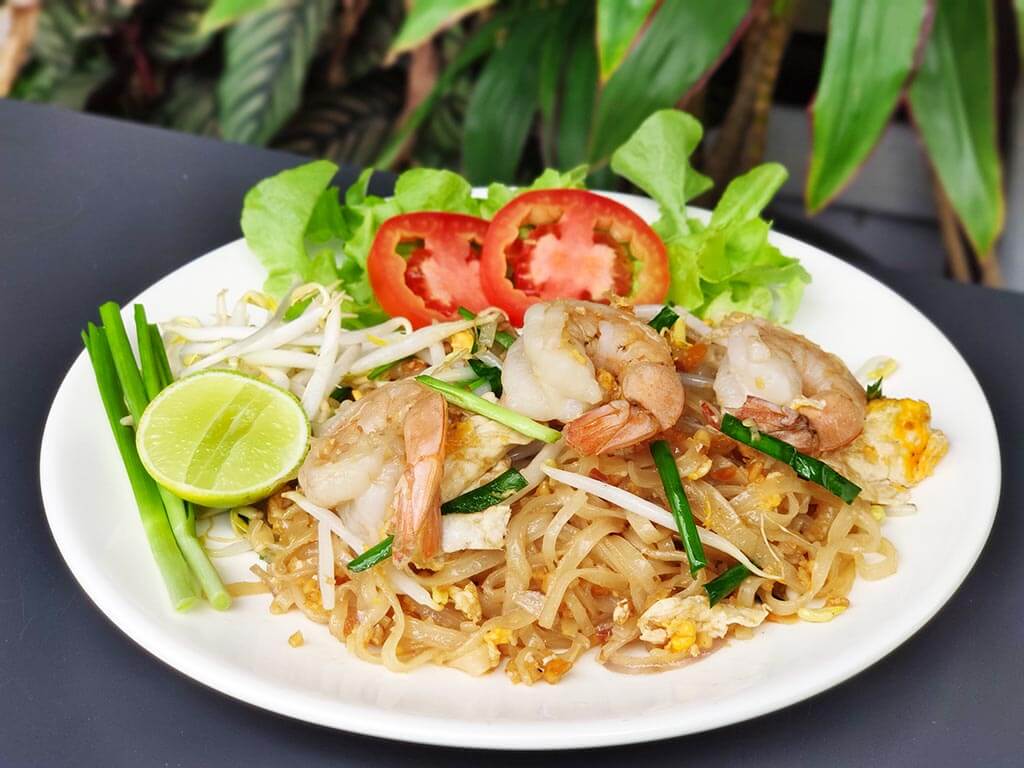
Pad Thai—Thai Stir-Fried Noodles
A Classic Chiang Mai Flavor You Shouldn’t Miss

Tom Yum (Hot & Sour Soup)
Staying true to our authentic taste
We’re all about keeping our Thai flavors authentic
— no compromises.
“Fresh, Tasty & Easy”
A great day can start with hot, made-to-order food bursting with real Thai flavor. From the very first bite, you’ll taste it: fresh ingredients, fragrant herbs, and that just-right balance of spicy, sour, salty, and sweet. This isn’t rushed, “good enough” food — it’s Thai cooking that keeps you coming back. What makes it even better is our warm, thoughtful service: friendly smiles, helpful recommendations, remembering your favorites, and happily adjusting the spice level to suit everyone.
Read More Chiang Mai Guides
Planning a trip to Chiang Mai?
Read more guides from the Thaan Aoan team to make planning your Chiang Mai trip easier.
Fuel Up Before or After Your Trip
Most family day trips start early or end late, so grab a proper Thai meal in the Old City before you head up to Doi Suthep or after a long day at the zoo.
Thaan Aoan is right in the Old City, near Wat Chedi Luang, open daily 7:00 AM to 9:00 PM.
Questions or table reservations: Contact us